

For years, you have worked diligently to build your career, provide for your family, and secure your financial future.
However, life can sometimes present profound and unexpected challenges. If a severe injury or illness suddenly prevents you from working, navigating the physical and emotional toll is difficult enough without the added stress of financial uncertainty.
During such challenging times, you may need to rely on your superannuation and Total and Permanent Disability (TPD) insurance to support your family, meet ongoing living expenses, and secure your home. These funds are designed to be your vital safety net.
Yet, there is an important factor to be mindful of: accessing your superannuation before reaching your preservation age can sometimes trigger unexpected tax liabilities. For many, discovering that a portion of their much-needed financial lifeline may be subject to tax is an overwhelming prospect.
Fortunately, there are structural provisions designed to support you in these exact circumstances. One of the most beneficial is the TPD tax-free uplift, a mechanism that can substantially reduce the tax payable on your withdrawal, helping to preserve your financial security.
In this guide, we will explore how the TPD tax-free uplift works, outline the relevant Australian Taxation Office (ATO) guidelines, and provide clarity on how to navigate this process to help minimise your tax obligations during a vulnerable time.
What is TPD Insurance?
Before diving into the tax rules, let's clarify exactly what we are dealing with. According to the Australian Government's MoneySmart website:
"Total and Permanent Disability (TPD) insurance pays a lump sum if an illness or injury leaves you permanently unable to work. This can help with living costs, medical care, home changes and one‑off expenses."
What is the TPD Tax-Free Uplift?
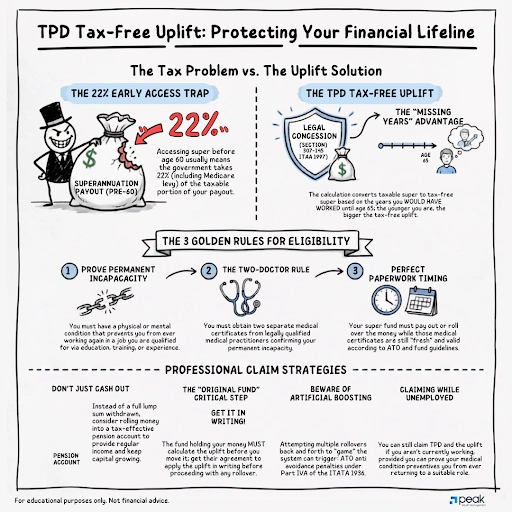
Normally, if you are under your "preservation age" (usually 60) and you pull money out of your super, the government taxes the taxable portion of that money at 22% (including the Medicare levy). On a $500,000 payout, that could mean losing over $100,000 to taxes. (Learn more about Transition to Retirement here).
The TPD tax-free uplift is a special concession designed to give you a break. Officially legislated under Section 307-145 of the Income Tax Assessment Act 1997 (ITAA 1997), it allows permanently incapacitated individuals to change the tax make-up of their super balance.
The calculation looks at the years you would have worked until normal retirement age (usually 65) and magically transforms a large chunk of your taxable super into tax-free super. The younger you are when you stop working, the bigger the tax-free uplift you get, because you are missing out on more working years.
The 3 Rules You Must Follow
To legally claim this massive tax break, you have to meet strict criteria:
- You must be permanently incapacitated: This means you have a physical or mental health condition that stops you from working ever again in a job you are qualified for through education, training, or experience.
- You need two doctors to sign off: You must provide two medical certificates from legally qualified medical practitioners confirming your permanent incapacity.
- The timing matters: Your super fund needs to pay out or roll over your money while those medical certificates are still considered valid. According to ATO ID 2015/19, a medical certificate is generally considered valid if the lump sum is paid over a "short period of time" from the certificate's issue date (though exact timeframes are dictated by your specific super fund's rules).
Claim Strategies: From a Financial Adviser's Perspective
Because we are financial advisers, we help clients navigate this exact nightmare all the time. Getting approved for TPD is only half the battle; structuring the payout so you don't get crushed by taxes is just as critical.
Here are our top strategies backed by tax law:
- Don't Just Cash Out Immediately: Many people panic and withdraw the whole lump sum to their bank account. This can still trigger taxes and will stop your money from growing. Instead, consider rolling the money over into a tax-effective pension account that pays you a regular income.
- The "Original Fund" Strategy (Handling Rollovers): We regularly see receiving super funds reject the tax-free uplift because the original fund forgot to calculate it or incorrectly assumed rollovers don't qualify. This is a common industry mistake. However, Section 307-15 of the ITAA 1997 (and confirmed in the September 2007 NTLG Superannuation technical sub-committee minutes) clearly states that a rollover made at your direction is legally treated as a payment to you. Therefore, the original fund must calculate the uplift before the money moves. Always double-check your rollover statements!
- ⚠️ CRITICAL ADVICE: Do not just tick the "rollover" box on an application and assume the fund will apply your tax break. You must get their agreement to apply the uplift in writing before you proceed with moving any providers.
- Beware of "Multiple Rollovers": Moving your money once to secure your uplift is perfectly legal. However, some people try to execute multiple rollovers back and forth between funds to artificially boost their tax-free component over and over. The ATO has strict anti-avoidance rules under Part IVA of the Income Tax Assessment Act 1936. Doing this can trigger severe penalties, and large super funds will often freeze your transfers if they suspect you are trying to game the system.
- Time Your Medical Certificates: Because of the ATO guidelines mentioned earlier, super funds are incredibly strict about paperwork. If your doctors signed your forms months ago, the fund might reject the tax-free uplift. Always coordinate the dates of your medical certificates closely with your actual withdrawal or rollover request. Note: Each fund has different rules around this.
Frequently Asked Questions (FAQs)
How much tax do you pay on TPD payout?
If you are under 60 and take a standard withdrawal, the taxable component of your super is usually taxed at 22% (including the Medicare levy). However, if you qualify for the TPD tax-free uplift, a significant portion of that money is converted into a tax-free component, drastically reducing or even eliminating the tax you have to pay.
Do you have to pay tax on a TPD payout?
Yes, typically you do have to pay tax on the taxable portion of a TPD payout if you take it as a lump sum before turning 60. However, by applying the tax-free uplift and seeking professional financial advice, you can legally minimise this tax burden.
Is there a TPD tax-free uplift calculator I can use?
While your super fund is legally responsible for doing the final maths, a standard TPD tax-free uplift calculator uses your "future service period" (the days between when you stopped working and your normal retirement age, usually 65) against your eligible service period to estimate how much of your balance becomes tax-free.
What are the TPD tax-free uplift ATO rules for rollovers?
The TPD tax-free uplift ATO guidelines confirm that the tax-free calculation can still be applied even if you decide to roll your lump sum benefit over to a different superannuation provider, rather than cashing it out. However, the original fund releasing the money is the one required to perform the calculation.
Can you claim TPD if not working?
Yes, you absolutely can claim TPD if not working. In fact, to qualify for a Total and Permanent Disability payout and the tax-free uplift, the core requirement is proving to the insurer and your fund that your medical condition prevents you from ever returning to work in a role you are reasonably qualified for.
Recent Posts
Here is a look at our key areas and some of our recent resources you can explore:
- Retirement Planning and Superannuation Advice Topic:
- Tax Planning (including Debt Recycling) Topic:
- Investment Advice (Property and Shares) Topic:
- Personal Financial Advice and Wealth Management:


 Book free discovery call